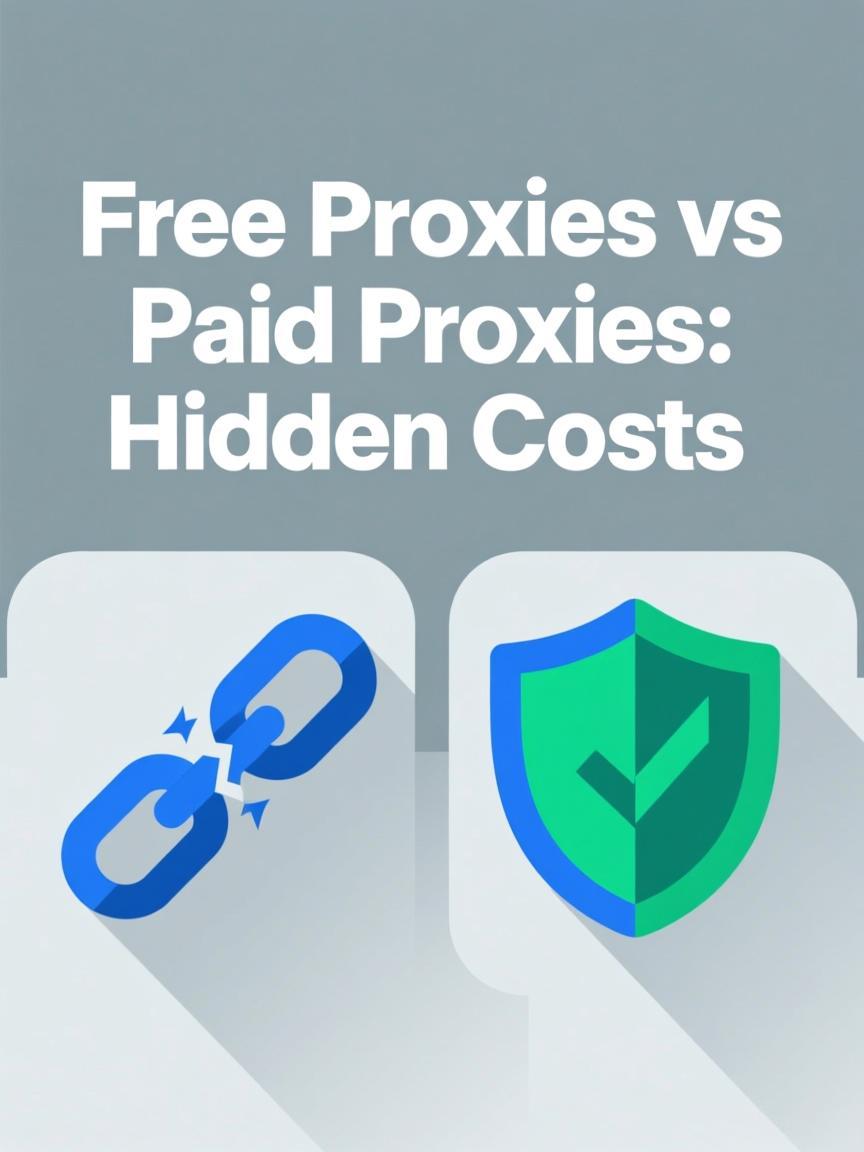
Free Proxies vs Paid Proxies: Hidden Costs
Last updated: 2026-02-02
Quick Definition
Free proxies are publicly available proxy servers that anyone can use without payment, typically found on public lists or free proxy websites. Paid proxies are commercial services with dedicated infrastructure, support, and guarantees. While free proxies appear cost-effective, hidden costs include security risks, unreliable performance, and high block rates—making paid proxies essential for any serious use case.
How Each Type Works
Free Proxy Reality:
┌─────────────────────────────────────────────────────────────────┐
│                                                                 │
│ Source: Public proxy lists, free proxy websites                 │
│                                                                 │
│ Who runs them?                                                  │
│ ├── Unknown operators (no accountability)                      │
│ ├── Honeypots (security researchers, attackers)                │
│ ├── Compromised servers (hacked without owner knowledge)       │
│ ├── Misconfigured servers (accidentally open)                  │
│ └── Marketing tools (collect user data)                        │
│                                                                 │
│ What they can see:                                              │
│ ├── All HTTP traffic content (unencrypted)                     │
│ ├── URLs visited                                                │
│ ├── Login credentials (if HTTP, not HTTPS)                     │
│ ├── Cookies and session data                                   │
│ └── Injected ads or malware into responses                     │
│                                                                 │
│ Typical Performance:                                            │
│ ├── Uptime: 10-50% (constantly dying)                          │
│ ├── Speed: 0.1-5 Mbps (overloaded)                              │
│ ├── Latency: 500ms-5000ms                                       │
│ └── Block rate: 80%+ on protected sites                        │
│                                                                 │
└─────────────────────────────────────────────────────────────────┘

Paid Proxy Infrastructure:
┌─────────────────────────────────────────────────────────────────┐
│                                                                 │
│ Source: Commercial proxy providers                              │
│                                                                 │
│ Who runs them?                                                  │
│ ├── Registered businesses (accountable)                        │
│ ├── Professional infrastructure teams                          │
│ ├── Support and documentation available                        │
│ └── Terms of service and privacy policies                      │
│                                                                 │
│ Security:                                                       │
│ ├── Encrypted connections (HTTPS/SOCKS5)                       │
│ ├── No traffic logging (reputable providers)                   │
│ ├── No content injection                                       │
│ └── Authentication required (your data protected)              │
│                                                                 │
│ Typical Performance:                                            │
│ ├── Uptime: 99%+ (SLA guarantees)                              │
│ ├── Speed: 50-500+ Mbps                                         │
│ ├── Latency: 20-100ms                                           │
│ └── Block rate: 5-30% (maintained IP pools)                    │
│                                                                 │
└─────────────────────────────────────────────────────────────────┘
Feature Comparison
| Feature | Free Proxies | Paid Proxies |
|---|---|---|
| Cost | $0 monetary | $1-50+/month or per GB |
| Hidden Cost | Security, time, reliability | None (transparent pricing) |
| Speed | 0.1-5 Mbps | 50-500+ Mbps |
| Uptime | 10-50% | 99%+ |
| IP Quality | Heavily blacklisted | Maintained, rotated |
| Security | None (data exposed) | Encrypted, authenticated |
| Support | None | Email, chat, documentation |
| Accountability | Unknown operators | Registered business |
Security Risk Comparison
| Risk Type | Free Proxies | Paid Proxies |
|---|---|---|
| Traffic interception | Common (MITM attacks) | Rare (encrypted) |
| Credential theft | High risk (HTTP logging) | Low (no logging policy) |
| Malware injection | Common (ad/script injection) | None |
| Session hijacking | Possible (cookie capture) | Protected |
| Data selling | Likely (monetization method) | Against ToS |
| Honeypot operation | Common | Not applicable |
Test any proxy's behavior with the Proxy Tester. Check what headers a proxy adds or modifies using the HTTP Headers Checker.
Real-World Performance Comparison
Test Results (100 request sample):
─────────────────────────────────────────────────────────────────

Free Proxy (random public list):
├── Successful: 23/100 (23%)
├── Timeout: 45/100 (45%)
├── Blocked: 22/100 (22%)
├── Error: 10/100 (10%)
├── Avg response time: 4,230ms
└── Data integrity: 3 responses had injected content

Paid Proxy (commercial provider):
├── Successful: 94/100 (94%)
├── Timeout: 2/100 (2%)
├── Blocked: 3/100 (3%)
├── Error: 1/100 (1%)
├── Avg response time: 340ms
└── Data integrity: 100% clean responses

─────────────────────────────────────────────────────────────────

Time Cost Calculation:
┌─────────────────────────────────────────────────────────────────┐
│ Free Proxy Scenario:                                            │
│ ├── Need 1000 successful requests                               │
│ ├── At 23% success: 4,348 attempts needed                       │
│ ├── At 4.2s avg: 5+ hours of execution time                     │
│ ├── Plus time finding working proxies                           │
│ └── Plus time dealing with corrupted data                       │
│                                                                 │
│ Paid Proxy Scenario:                                            │
│ ├── Need 1000 successful requests                               │
│ ├── At 94% success: 1,064 attempts needed                       │
│ ├── At 0.34s avg: 6 minutes of execution time                   │
│ └── Clean data, no manual intervention                          │
└─────────────────────────────────────────────────────────────────┘
Use Case Analysis
| Use Case | Free Proxies | Paid Proxies |
|---|---|---|
| Learning/education | Acceptable (understand risks) | Recommended |
| One-time test | Maybe (low stakes only) | Preferred |
| Production scraping | Not viable | Required |
| Account management | Dangerous (credential exposure) | Required |
| E-commerce | Not viable (high block rate) | Required |
| Sensitive data handling | Never | Required |
| Business operations | Unprofessional, risky | Standard practice |
| Bypassing geo-restrictions | Rarely works | Reliable |
True Cost Calculation
Hidden Costs of "Free":
─────────────────────────────────────────────────────────────────

Time Waste:
├── Finding working proxies: 1-2 hours/week
├── Debugging failures: 3-5 hours/week
├── Retry overhead: 4x more requests needed
└── At $50/hour rate: $200-350/week in lost time

Security Incidents:
├── Credential compromise: Recovery + damage control
├── Malware cleanup: IT time, potential data loss
├── Session hijacking: Account recovery efforts
└── Potential cost: $1,000-10,000+ per incident

Opportunity Cost:
├── Blocked from target sites (need to wait/switch)
├── Corrupted data (re-work analysis)
├── Unreliable automation (manual intervention)
└── Reputation damage (if used for business)

─────────────────────────────────────────────────────────────────

Break-Even Analysis:
┌─────────────────────────────────────────────────────────────────┐
│ Paid proxy cost: $50/month                                      │
│ Time value: $50/hour                                            │
│                                                                 │
│ If free proxies waste just 1 hour/month:                        │
│ → Paid proxies are more economical                              │
│                                                                 │
│ Reality: Free proxies typically waste 5-20+ hours/month        │
│ → Paid proxies save $200-1000+/month in real costs              │
└─────────────────────────────────────────────────────────────────┘
FAQ
Why do free proxies exist if they're so bad?
Various motivations: security researchers running honeypots to study attacks, malicious actors harvesting credentials, marketing tools collecting browsing data, or simply misconfigured servers. Some are genuinely altruistic but quickly become overloaded and unreliable. The economics don't support quality free services at scale.
Are there any safe free proxies?
Trusted organizations (universities, nonprofits) occasionally offer free proxies for specific purposes. Browser-based free tiers from established providers may be safe but severely limited. For any real use case, the risk-reward calculation strongly favors paid services. Assume any random free proxy is compromised.
Can free proxies steal my passwords?
For HTTP (not HTTPS) connections, yes—the proxy sees all traffic including login forms. For HTTPS, the proxy sees the domain but not the content. However, malicious proxies can attempt SSL stripping attacks or inject fake certificate warnings hoping users click through. Always verify HTTPS connections when using any proxy.
Why are free proxy lists always outdated?
Free proxies die constantly—misconfigured servers get fixed, temporary proxies go offline, overloaded proxies crash. Lists can't keep up. By the time a proxy appears on a public list, it's likely been hammered by thousands of users and either blocked or offline. This is why success rates are typically under 25%.
How much should I pay for quality proxies?
Depends on type and volume. Datacenter proxies: $1-3/IP/month. Residential: $5-15/GB. Mobile: $15-50/GB. ISP (static residential): $2-5/IP/month. Compare providers on reliability and support, not just price. The cheapest paid proxy is still orders of magnitude better than free alternatives.
Is using free proxies illegal?
Using free proxies isn't inherently illegal, but using compromised servers unknowingly could involve you in illegal activity. If the proxy is a hacked server, you're routing traffic through unauthorized infrastructure. Paid services from legitimate providers eliminate this legal gray area.
Related Tools
- Proxy Tester - Test proxy reliability before use
- HTTP Headers Checker - Detect injected headers
- IP Checker - Verify proxy IP and classification
Ready to start scraping?
Get access to millions of residential proxies across 195+ countries. Instant activation.
Get Started Now