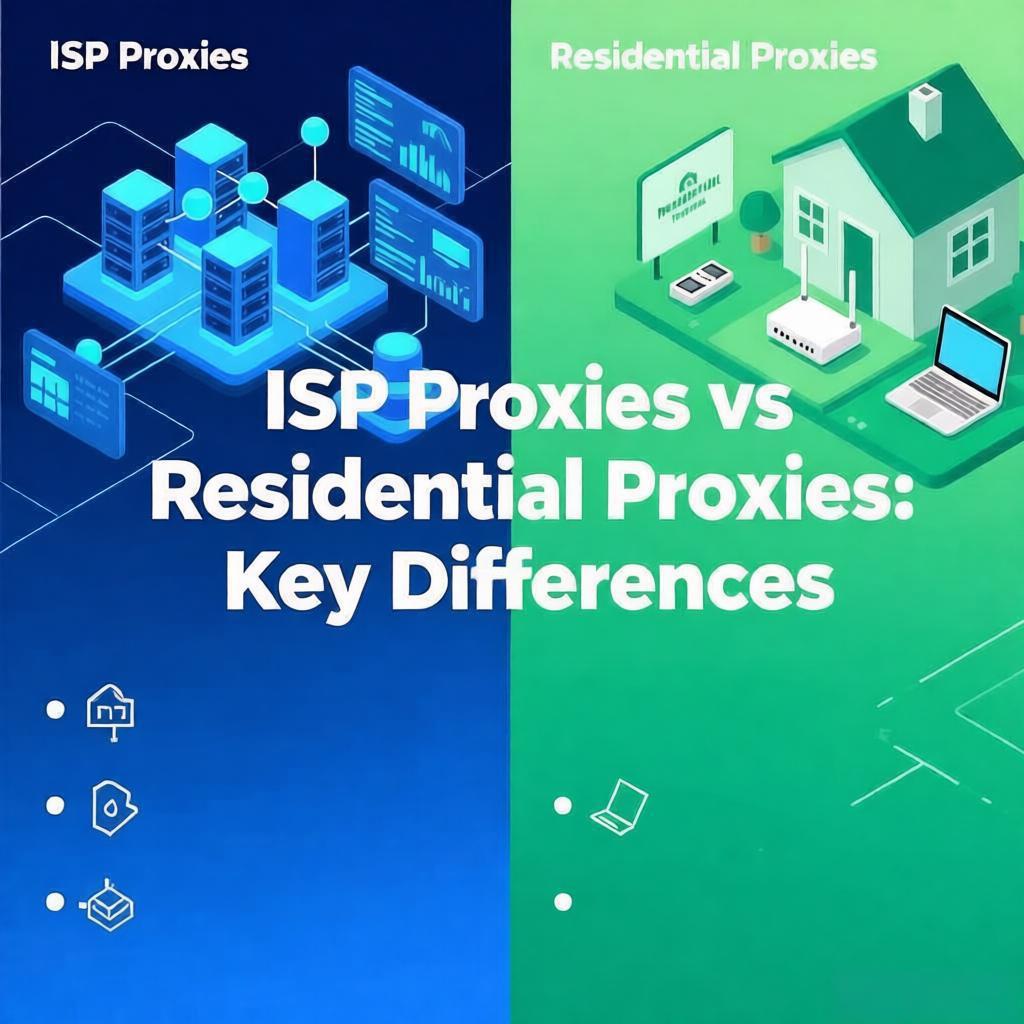
ISP Proxies vs Residential Proxies: Key Differences
Last updated: 2026-02-16
Quick Definition
ISP proxies (static residential) are datacenter-hosted servers with IP addresses registered under residential ISP ASNs, providing the classification of residential IPs with datacenter-level speed and reliability. Residential proxies route traffic through actual home user devices via peer networks, offering authentic residential connections but with variable performance. The key difference: ISP proxies are infrastructure-based with static IPs, while residential proxies are peer-based with rotating IPs.
How Each Type Works
ISP Proxy (Static Residential):
┌─────────────────────────────────────────────────────────────────┐
│                                                                 │
│ Your Request → Datacenter Server → Internet → Target           │
│                  (with ISP-registered IP)                       │
│                                                                 │
│ Infrastructure:                                                 │
│ ├── Physical server in datacenter                               │
│ ├── IP purchased from ISP (not hosting provider)               │
│ ├── ASN: Consumer ISP (Comcast, AT&T, Verizon)                 │
│ ├── Classification: Residential in databases                   │
│ └── Connection: Direct, low-latency, high-bandwidth            │
│                                                                 │
│ Example IP: 73.45.167.89                                        │
│ ├── Location: Datacenter in New York                            │
│ ├── ASN: AS7922 (Comcast) ← ISP, not hosting                   │
│ ├── Database: Listed as "residential"                          │
│ └── Speed: 1 Gbps (datacenter connection)                       │
│                                                                 │
└─────────────────────────────────────────────────────────────────┘

Residential Proxy (Peer-Based):
┌─────────────────────────────────────────────────────────────────┐
│                                                                 │
│ Your Request → Gateway → Home Device → Home Router → Target    │
│                           (peer user)                           │
│                                                                 │
│ Infrastructure:                                                 │
│ ├── Traffic routes through real home connections               │
│ ├── Peer devices run proxy SDK (opt-in users)                  │
│ ├── ASN: Consumer ISP                                          │
│ ├── Classification: Residential                                │
│ └── Connection: Variable (depends on peer's internet)          │
│                                                                 │
│ Example IP: 73.45.167.89                                        │
│ ├── Location: Actual home in Philadelphia                      │
│ ├── ASN: AS7922 (Comcast)                                      │
│ ├── Database: Listed as "residential"                          │
│ └── Speed: 50-300 Mbps (home broadband)                         │
│                                                                 │
│ Peer may go offline at any time (shared home connection)       │
│                                                                 │
└─────────────────────────────────────────────────────────────────┘
Feature Comparison
| Feature | ISP Proxies | Residential Proxies |
|---|---|---|
| IP Source | ISP IPs on datacenter servers | Real home user devices |
| IP Persistence | Static (weeks/months) | Rotating (per request/session) |
| Exclusivity | Dedicated to you | Shared pool |
| Speed | Consistent, high (datacenter) | Variable (peer-dependent) |
| Latency | Low (10-30ms) | Higher (50-200ms) |
| Uptime | 99.9% (server infrastructure) | Variable (peers offline randomly) |
| Pool Size | Thousands per region | Millions globally |
| Pricing | Per IP per month ($2-5) | Per GB ($5-15) |
Technical Specifications
| Specification | ISP Proxies | Residential Proxies |
|---|---|---|
| Infrastructure | Dedicated servers | Peer SDK network |
| IP Assignment | Allocated IP blocks from ISPs | Dynamic from peer pool |
| Connection Type | Direct server connection | Routed through gateway + peer |
| Bandwidth | 100 Mbps - 1 Gbps | 10 - 500 Mbps (variable) |
| Geographic Precision | City-level available | Country/city based on peer location |
| Session Handling | Natural (same IP = same session) | Requires sticky session config |
| Concurrent Connections | Unlimited per IP typically | May be limited per session |
Use Case Comparison
| Use Case | Best Choice | Reason |
|---|---|---|
| Account management | ISP | Need consistent IP for login history |
| E-commerce accounts | ISP | Platforms track IP consistency |
| Checkout/purchasing | ISP | Payment requires stable identity |
| Large-scale scraping | Residential | Need IP diversity to avoid patterns |
| Price comparison | Residential | Many sites, rotation prevents blocks |
| Ad verification | Residential | Need diverse geographic views |
| Speed-critical operations | ISP | Datacenter performance required |
| Long-running sessions | ISP | Stable connection for hours/days |
Test proxy speed and stability with the Proxy Tester. Verify residential classification using the IP Checker.
Detection Comparison
Detection Risk Analysis:
─────────────────────────────────────────────────────────────────

ISP Proxies:
├── ASN Check: PASS (registered to ISP)
├── IP Database: Residential
├── Reverse DNS: Usually ISP pattern
├── Speed Anomaly: POTENTIAL FLAG
│   └── Datacenter speeds from "home" IP might trigger review
├── Usage Pattern: Risk if high volume from single IP
└── Overall: Low detection, but consistent identity is tracked

Residential Proxies:
├── ASN Check: PASS (registered to ISP)
├── IP Database: Residential
├── Reverse DNS: ISP pattern
├── Speed Anomaly: Normal (matches home speeds)
├── Usage Pattern: Rotation prevents pattern building
└── Overall: Very low detection, but peer instability issues

─────────────────────────────────────────────────────────────────

Scenario: Target with sophisticated detection
┌─────────────────────────────────────────────────────────────────┐
│ ISP Proxy Risk:                                                 │
│ Target sees same IP making 10,000 requests/day                  │
│ → Behavioral block (rate limiting)                              │
│                                                                 │
│ Residential Proxy Advantage:                                    │
│ 10,000 requests spread across 1,000 different IPs              │
│ → Each IP makes only 10 requests → Normal behavior              │
└─────────────────────────────────────────────────────────────────┘
FAQ
Why are ISP proxies sometimes called "static residential"?
Because they combine residential IP classification (ISP ASN registration) with static assignment (same IP for months). Unlike rotating residential proxies from peer networks, ISP proxies give you a dedicated, unchanging IP address that still appears residential to target websites.
Can websites detect that ISP proxies are datacenter-hosted?
Advanced detection might notice datacenter-like behavior (extremely fast speeds, 100% uptime patterns) from an IP classified as residential. However, since the IP is genuinely registered to an ISP, ASN-based blocking won't work. Most sites lack the sophistication for this level of analysis.
Which is more anonymous: ISP or residential proxies?
Residential rotating proxies offer more anonymity through IP diversity—each request can come from a different IP. ISP proxies provide a consistent identity, which is less anonymous but necessary for operations requiring persistent sessions. Choose based on whether you need anonymity or consistency.
Why are residential proxies priced per GB while ISP proxies are per IP?
Residential proxies share bandwidth from peer networks with variable usage patterns, making GB-based pricing fair. ISP proxies are dedicated servers with allocated IPs—the cost is the IP allocation and server uptime, not traffic volume. Different infrastructure models require different pricing structures.
Can I switch from residential to ISP proxies mid-project?
Yes, but plan the transition. If managing accounts, you'll need to gradually associate them with new static IPs. For scraping, the switch is immediate but changes your detection profile. Consider using both: residential for discovery/research, ISP for consistent target engagement.
Do ISP proxies work for all regions?
ISP proxy availability varies by region. Major markets (US, UK, DE) have good coverage. Smaller countries may have limited ISP proxy inventory or higher prices. Residential rotating proxies typically offer broader geographic coverage through global peer networks.
Related Tools
- IP Checker - Verify residential IP classification
- Proxy Tester - Compare speed and latency
- DNS Lookup - Check reverse DNS patterns
Ready to start scraping?
Get access to millions of residential proxies across 195+ countries. Instant activation.
Get Started Now