IPv4 vs IPv6 Proxies: Compatibility and Use Cases
Last updated: 2026-02-17
Quick Definition
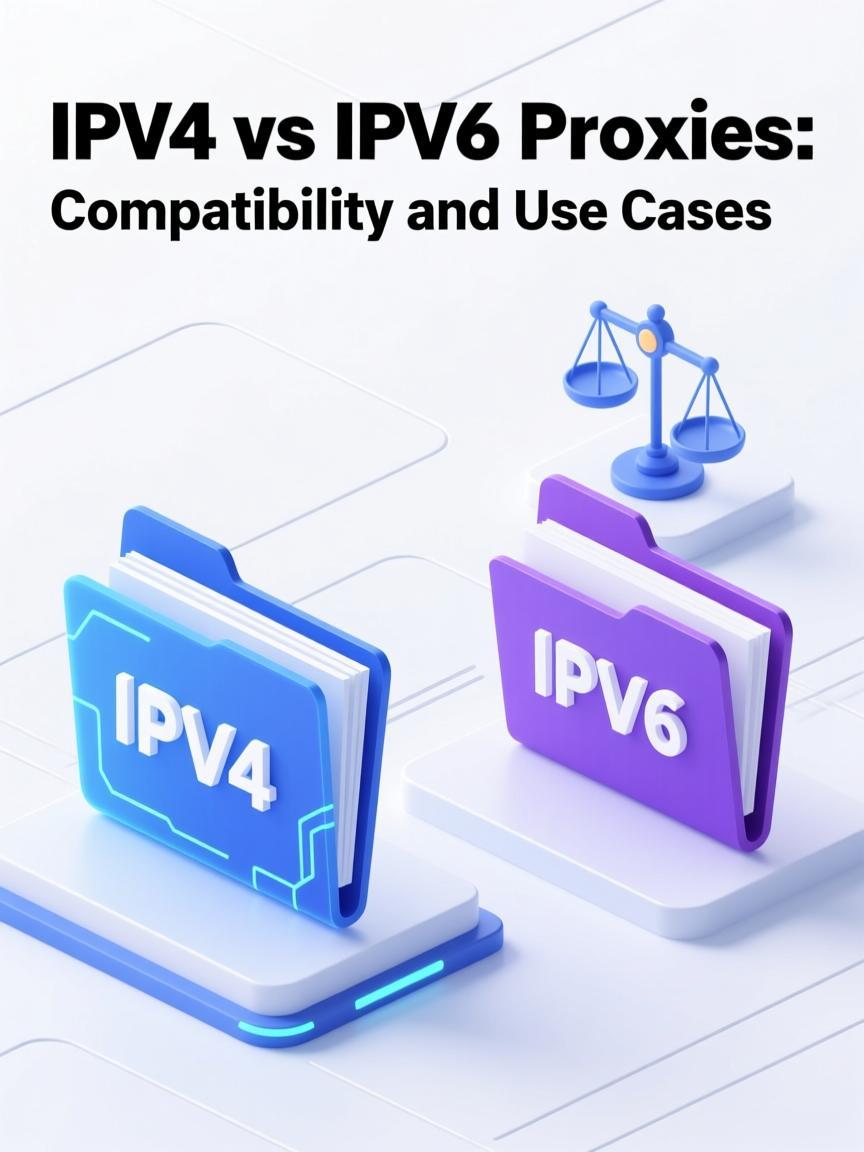
IPv4 proxies use the traditional 32-bit addressing system (e.g., 192.168.1.1) that powers most of the current internet. IPv6 proxies use the newer 128-bit addressing system (e.g., 2001:0db8:85a3::8a2e:0370:7334) designed to overcome IPv4 address exhaustion. While IPv6 offers virtually unlimited addresses at lower costs, compatibility limitations mean IPv4 remains essential for most proxy use cases—many websites still don't fully support IPv6.
How Each Version Works
IPv4 Addressing:
┌─────────────────────────────────────────────────────────────────┐
│                                                                 │
│ Format: 32-bit (4 octets)                                       │
│ Example: 192.168.1.1                                            │
│                                                                 │
│ Total Addresses: 4.3 billion (2^32)                             │
│ Status: Exhausted - all addresses allocated                     │
│                                                                 │
│ Representation:                                                 │
│ 11000000.10101000.00000001.00000001 (binary)                   │
│ 192.168.1.1 (dotted decimal)                                   │
│                                                                 │
│ Typical Proxy Format:                                           │
│ 198.51.100.45:8080 (IP:port)                                   │
│                                                                 │
└─────────────────────────────────────────────────────────────────┘

IPv6 Addressing:
┌─────────────────────────────────────────────────────────────────┐
│                                                                 │
│ Format: 128-bit (8 groups of 16 bits)                           │
│ Example: 2001:0db8:85a3:0000:0000:8a2e:0370:7334                │
│                                                                 │
│ Total Addresses: 340 undecillion (2^128)                        │
│ Status: Abundant - virtually unlimited                          │
│                                                                 │
│ Shortened Notation:                                             │
│ 2001:0db8:85a3::8a2e:0370:7334 (:: replaces consecutive zeros) │
│                                                                 │
│ Typical Proxy Format:                                           │
│ [2001:db8:85a3::8a2e:370:7334]:8080 (brackets around IP)       │
│                                                                 │
└─────────────────────────────────────────────────────────────────┘
Feature Comparison
| Feature | IPv4 Proxies | IPv6 Proxies |
|---|---|---|
| Address Length | 32 bits | 128 bits |
| Total Addresses | ~4.3 billion | ~340 undecillion |
| Availability | Scarce (exhausted) | Abundant |
| Website Compatibility | Universal (100%) | Partial (~40% of sites) |
| Cost per IP | Higher ($1-5/month) | Lower ($0.01-0.10/month) |
| Reputation Data | Extensive (years of history) | Limited (newer IPs) |
| NAT Requirement | Common (address sharing) | Rare (sufficient addresses) |
| Detection Databases | Comprehensive | Still developing |
Compatibility Matrix
| Target Type | IPv4 Support | IPv6 Support |
|---|---|---|
| Major search engines | Full | Full |
| Social media platforms | Full | Partial (varies) |
| E-commerce sites | Full | Limited |
| News/content sites | Full | Moderate |
| Government sites | Full | Varies by country |
| Banking/financial | Full | Often blocked |
| CDN-hosted content | Full | Usually supported |
| Legacy systems | Full | None |
Check website IPv6 support using the DNS Lookup tool to find AAAA records. Verify your proxy connectivity with the Proxy Tester.
Use Case Comparison
| Use Case | Recommended | Reason |
|---|---|---|
| General web scraping | IPv4 | Universal compatibility |
| Social media | IPv4 | Inconsistent IPv6 support |
| Search engine scraping | IPv6 viable | Google, Bing support IPv6 |
| E-commerce | IPv4 | Most stores lack IPv6 |
| High-volume testing | IPv6 | Cost-effective for scale |
| Account creation at scale | IPv6 (where supported) | Fresh IPs, low cost |
| API access | IPv4 | Most APIs IPv4-only |
| Mixed target portfolio | IPv4 | Guaranteed to work everywhere |
Cost Analysis
Price Comparison (2026 Market Rates):
─────────────────────────────────────────────────────────────────

IPv4 Proxies:
├── Datacenter: $1-3 per IP/month
├── Residential: $2-5 per IP/month
├── Mobile: $5-15 per IP/month
└── Why expensive: Fixed supply, high demand

IPv6 Proxies:
├── Datacenter: $0.01-0.10 per IP/month
├── Often sold as /64 or /48 subnets
├── /64 subnet: ~18 quintillion IPs for $50-200/month
└── Why cheap: Virtually unlimited supply

─────────────────────────────────────────────────────────────────

Subnet Pricing Example:
┌─────────────────────────────────────────────────────────────────┐
│ IPv6 /64 Subnet:                                                │
│ ├── Addresses: 18,446,744,073,709,551,616 IPs                   │
│ ├── Cost: $50-200/month                                         │
│ └── Per-IP cost: Essentially $0                                 │
│                                                                 │
│ IPv6 /48 Subnet:                                                │
│ ├── Contains: 65,536 /64 subnets                                │
│ ├── Addresses: 1.2 × 10^24 IPs                                  │
│ └── Used for enterprise-scale rotation                          │
└─────────────────────────────────────────────────────────────────┘

When IPv6 Cost Savings Matter:
├── Target confirmed to support IPv6
├── Need massive IP rotation
├── Budget-constrained high-volume projects
└── Testing before production (IPv4)
Detection Considerations
IPv6 Detection Landscape:
─────────────────────────────────────────────────────────────────

Advantages of IPv6 for Detection Evasion:
├── Newer addresses = less reputation data
├── Vast address space = harder to blacklist ranges
├── Many IPs appear "fresh" to detection systems
└── Lower presence in existing blacklists

Disadvantages of IPv6:
├── Entire /64 subnets can be blocked together
├── Unusual for some regions/use cases (suspicious)
├── Less sophisticated fingerprinting data
└── Some systems flag IPv6-only as anomaly

─────────────────────────────────────────────────────────────────

How Websites Block IPv6:
┌─────────────────────────────────────────────────────────────────┐
│ Can't block individual IPs (too many)                           │
│ Instead block by:                                               │
│ ├── /64 subnet (most common allocation)                         │
│ ├── /48 or larger blocks                                        │
│ ├── ASN (entire provider)                                       │
│ └── Behavioral patterns within subnet                           │
│                                                                 │
│ If one IP in your /64 triggers abuse:                           │
│ → Entire /64 may be blocked                                     │
│ → Need new subnet, not just new IP                              │
└─────────────────────────────────────────────────────────────────┘
FAQ
Can I use IPv6 proxies for any website?
No. Many websites only have IPv4 connectivity (no AAAA DNS record). Attempting to connect via IPv6 to an IPv4-only site will fail. Check target support using DNS lookup for AAAA records before using IPv6 proxies. Major platforms like Google support IPv6; many e-commerce and smaller sites don't.
Why are IPv6 proxies so much cheaper?
Supply and demand. IPv4 addresses are exhausted—no new ones can be created—making existing IPs scarce and valuable. IPv6 offers practically unlimited addresses; providers can allocate millions of IPs from a single subnet at minimal cost. The infrastructure cost is similar, but IP cost approaches zero.
Is IPv6 more anonymous than IPv4?
Not inherently. While IPv6 addresses have less historical reputation data (newer), this advantage is temporary. Sophisticated detection focuses on behavior, not just IP history. Additionally, IPv6 subnets can be blocked wholesale—if one IP in your /64 is flagged, the entire block may be blocked.
Should I use IPv6 for scraping Google?
Google fully supports IPv6, making it viable. IPv6 offers cost advantages for high-volume SERP scraping. However, monitor for /64 subnet blocks—if detected, you may need to rotate to new subnets rather than just new IPs. IPv4 remains the safe choice if budget allows.
How do I check if a website supports IPv6?
Perform a DNS lookup for AAAA records. If the domain returns an AAAA record (IPv6 address), the site supports IPv6. If only A records (IPv4) exist, IPv6 connections will fail. Tools and command-line utilities like dig AAAA domain.com or nslookup -type=AAAA domain.com provide this information.
Can I use both IPv4 and IPv6 together?
Yes. A hybrid approach uses IPv6 for compatible targets (cost savings) and falls back to IPv4 for sites without IPv6 support. This maximizes cost efficiency while maintaining universal access. Implement logic to check target IPv6 support before routing requests.
Related Tools
- DNS Lookup - Check AAAA records for IPv6 support
- Proxy Tester - Test IPv4 and IPv6 proxy connectivity
- IP Checker - Verify your proxied IP address
Ready to start scraping?
Get access to millions of residential proxies across 195+ countries. Instant activation.
Get Started Now